


Pressures, Possibilities, and Precautions | HAI's 2026 AI Signature Research Report
Our partners, History Associates Inc. (HAI) recently conducted a 2026 AI Signature Research Report, drawing on survey responses from professionals working across the heritage, archival, and litigation sectors. Their report highlights how AI is reshaping heritage and archival work.
For more than 45 years, HAI has helped historians and archivists research and write histories, create educational experiences, preserve and manage historical content, and conduct specialized historical research for corporations, government agencies, law firms, and nonprofit organizations worldwide.
Used effectively, AI has the potential to support stewardship, improve operational efficiency, and widen access to collections, while still protecting trust, provenance, and professional judgement.
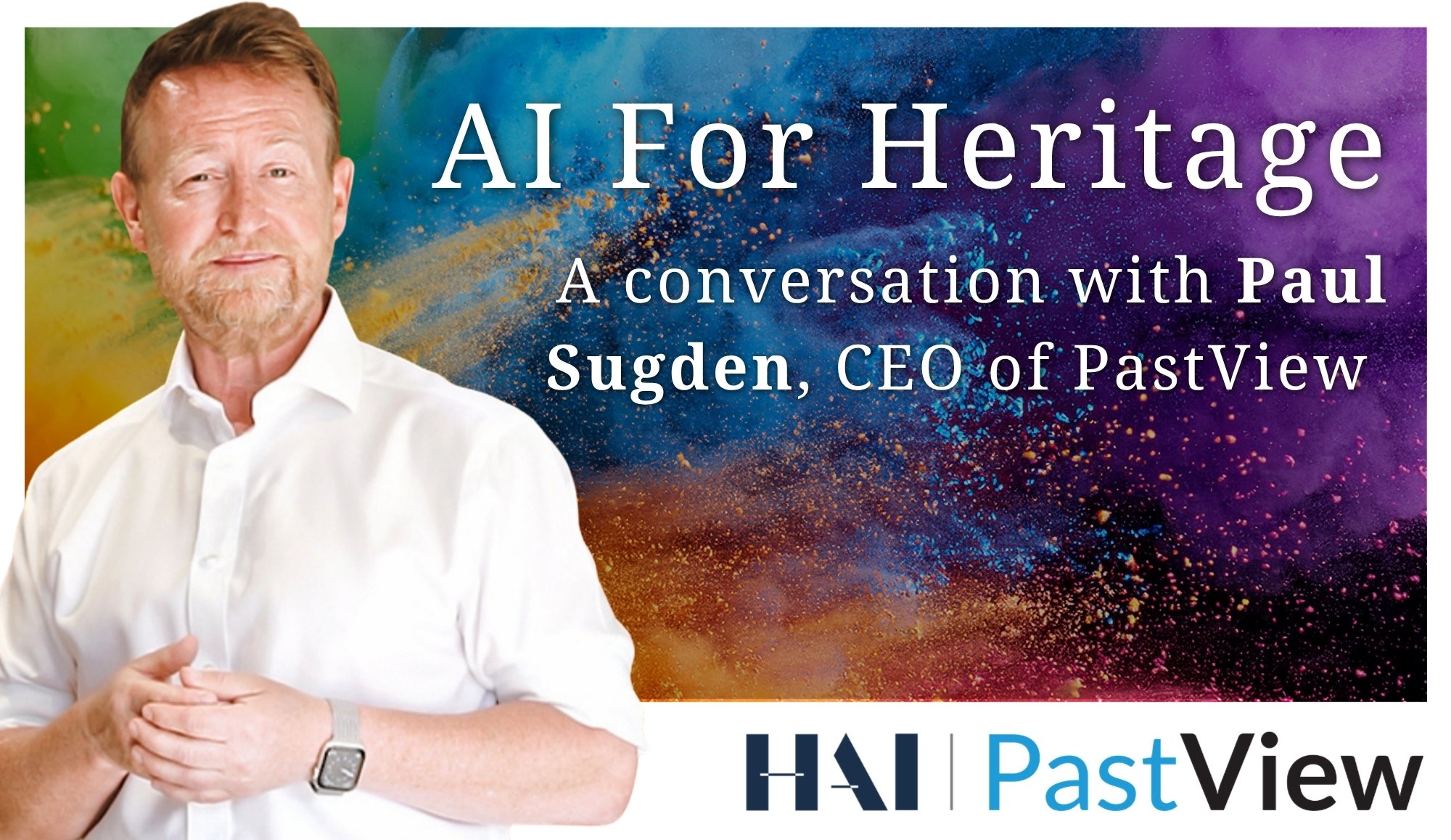
To explore these themes in more detail, we spoke with Paul Sugden, CEO of PastView, HAI’s premier heritage technology partner. PastView plays an important role within HAI’s heritage services ecosystem, providing digital access, AI-assisted discovery, and presentation-led tools that help organizations make better use of their collections.
In this interview, Paul shares practical insights from his work with organizations across the UK, US, and internationally. He offers a grounded view of where AI is already delivering value, where challenges remain, and how heritage leaders can prepare for the next stage of digital transformation.
1. AI Adoption Is Accelerating, But Progress Is Uneven
Q: HAI's research indicates that organizations feel pressure to adopt AI, yet many lack clarity on where to begin. From your perspective in the UK and internationally, where are heritage organizations making the most progress, and where do challenges remain?
____
Paul Sugden: Heritage organizations make the most progress when AI helps with access, discovery, and efficiency. However, many still find it hard to fully address strategy, skills, and governance.
Organizations are adopting AI where the benefits are immediate, low risk, and aligned with their mission. Enthusiasm is high, but clarity is sometimes lacking.
Heritage organizations are gaining the most traction when considering:
- AI-assisted discovery and search. This is where adoption is strongest. Tools like semantic search, entity extraction, and automated tagging help users find material faster and improve access without changing existing workflows. Many organizations use PastView’s AI-powered discovery features as their first step.
- Digitization workflow support. This is not full automation, but rather helps with tasks like OCR enhancement, transcription, metadata enrichment, and quality checks. These improvements bring clear operational benefits and are easy to justify within organizations.
- Audience engagement and interpretation. Institutions are carefully trying out AI-generated summaries and thematic groupings. They see that AI can help bring hidden stories to light.
And, organizations are often stuck when considering:
- Strategic clarity. Some institutions don’t yet know whether AI is a technical upgrade, a discovery tool, a storytelling engine, or a risk to be managed.
- Skills and confidence. Institutions sometimes lack the expertise to evaluate AI tools or understand what “good” looks like. This leads to hesitation, especially around governance, copyright, and ethical use.
- Governance and risk. Concerns about accuracy, bias, and provenance remain major blockers. There seems to be an appetite to innovate, but they also want to protect trust.
One of the most exciting areas is AI-assisted facial and content recognition:
- Many institutions hold thousands of photographs that were never fully reviewed, moderated, or tagged.
- As a result, images containing the same individuals, groups, or events often remain unlinked.
- Facial/Content recognition allows PastView to surface these potential matches, giving archivists a starting point to confirm identities, enrich metadata, and reconnect fragmented stories.
In summary, the biggest progress comes from AI tools in discovery, such as facial recognition, that uncover connections in unreviewed collections. PastView is seen as a safe introduction to AI as it addresses heritage needs directly and enhances collection access without reducing institutional control.
“The institutions that thrive will be the ones that stay curious, stay open, and stay ready to adapt.” - Paul Sugden, CEO of PastView
2. The Demand for “Clarity Over Complexity.”
Q: One of the strongest findings in HAI's report is that leaders want AI that is transparent, explainable, and aligned with the mission. How is PastView designing AI-enabled features that deliver value without confusing users or compromising stewardship?
____
Paul Sugden: Heritage leaders consistently stress that AI must be transparent, explainable, and mission-aligned. We make these principles central to PastView’s AI design, aiming to deliver clear value without user confusion or stewardship compromise.
PastView provides options for automatically applying AI outputs. Suggestions such as a tag, a transcription, a potential match, and a connection are presented as proposed, not final. The archivist remains the decision maker.
This ensures AI enhances professional judgment rather than replacing it.
Also, the platform attempts to be explicit about:
- Which documents or items were used to derive the response
- Why a suggestion was made
- What evidence the AI is basing it on
Nothing is hidden. Users can always trace the output back to the underlying material.
In summary, ensuring user traceability and transparency is critical to building trust, supporting provenance, and meeting audit requirements with AI.
And PastView focuses on using models that can run locally within a controlled infrastructure, which:
- Reduces or eliminates the need to send collection data to third-party AI services
- Keeps sensitive material within the organization’s governance boundary
- Aligns with sector expectations around privacy, ethics, and stewardship
AI is integrated into familiar PastView workflows, which means:
- No sudden automation
- Predictable, explainable interactions
Users always understand what the AI is doing and why.
PastView’s AI philosophy is built around clarity, control, and cultural responsibility. We design AI features that are transparent, explainable, and privacy-respecting, ensuring institutions can adopt AI confidently without losing sight of their mission or duty of care.
“Digitization preserves the asset; PastView makes it usable.” - Paul Sugden, CEO of PastView
3. AI + Collections Intelligence
Q: The report highlights a growing need for AI that strengthens discovery, access, and collections intelligence. How is PastView thinking about AI’s role in helping institutions surface connections, patterns, and stories that would otherwise remain hidden?
____
Paul Sugden: The report is absolutely right: the sector is looking for AI that deepens discovery and collections intelligence, not just automation. That’s exactly how PastView approaches AI. It provides institutions with a way to surface the connections, patterns, and stories that would otherwise remain hidden.
Most heritage organizations hold far more insight in their collections than they can realistically process.
PastView uses AI to surface:
- Recurring themes
- Relationships between people, places, and events
- Clusters of related material
- Patterns across time, geography, or subject matter
The key takeaway: AI’s role is to uncover existing stories and insights within collections, rather than create new narratives.
One of the most powerful ways AI strengthens discovery is by allowing users to search in natural language.
Instead of guessing keywords, users can ask:
- “Show me photographs of community celebrations in the 1950s.”
- “Find letters that mention early railway expansion.”
- “What do we know about this family name across the collection?”
AI interprets the intent, refines the query, and surfaces relevant details faster, especially in collections with inconsistent or sparse metadata.
Ultimately, this approach makes collections more accessible for researchers, communities, and staff, lowering the barrier to discovery for all.
“The sector is looking for AI that deepens discovery and collections intelligence, not just automation.” - Paul Sugden, CEO of PastView
4. Governance, Ethics, and Trust
Q: Across sectors, leaders told us they’re concerned about governance, bias, and long-term sustainability. How is PastView approaching responsible AI, and what does “ethical implementation” look like in a heritage context?
____
Paul Sugden: Across sectors, leaders are right to be concerned about governance, bias, and long-term sustainability. And in heritage, those concerns are amplified because the material we’re dealing with carries cultural, emotional, and historical weight.
Certainly, and importantly, we cannot ignore bias. Bias exists everywhere. In historical records, in cataloging practices, in community memory, and in the datasets AI learns from. Pretending that bias can be eliminated is unrealistic. The responsible approach is to acknowledge it, surface it, and design around it. PastView’s stance is simple. Biases are inherent in almost all areas of our lives and work, which filters back to transparency: be open about the data, where it comes from, and how it is composed.
Heritage collections often contain:
- Personal histories
- Community identities
- Culturally sensitive material
- Records with political or emotional significance
Ethical AI in this context means:
- No automatic publishing of AI-generated content
- No automated identification of individuals
- Careful handling of sensitive material
- Workflows that keep human judgment at the center
In summary, AI should always support, not override, human interpretation, especially with sensitive heritage material.
Responsible AI in heritage is about trust, transparency, and long-term care. PastView’s approach is to build AI that is governed, bias-aware, culturally sensitive, and sustainable. We support human expertise and champion the mission of preserving and understanding cultural memory.
“PastView’s AI philosophy is built around clarity, control, and cultural responsibility.” - Paul Sugden, CEO of PastView
5. Activation as the Next Frontier
Q: HAI's research shows a shift from “digitize and store” to “digitize and activate.” How is PastView helping organizations move beyond preservation to create meaningful engagement, storytelling, and community value?
____
Paul Sugden: The shift from “digitize and store” to “digitize and activate” reflects a bigger change in how heritage organizations think about their digital collections. It’s no longer enough to preserve material; institutions want to use it in order to spark engagement, support learning, and reconnect communities with their histories. PastView is designed specifically to support that evolution.
PastView, first and foremost, is a presentation layer for archives. This is not an afterthought; it’s the foundation, and always has been!
Because of this, the platform already provides:
- Multiple ways to display, contextualize, and interpret material
- Flexible storytelling tools
- Interfaces that make collections approachable for non-specialists
- Pathways that guide users through themes, narratives, and relationships
Digitization preserves the asset; PastView makes it usable.
Activation begins with access, and PastView (current and future features) offers a wide range of methods to make data discoverable:
- Intuitive browsing
- Thematic groupings
- Curated exhibitions
- Timeline and map-based exploration
- Natural language search that lets users ask questions in everyday language
This lowers the barrier for community members, educators, and researchers who want to explore but don’t know where to start.
PastView helps organizations move beyond preservation by transforming digitized collections into living cultural resources that are accessible, interpretable, narratable, and participatory. As a presentation-first platform, it gives institutions the tools to activate their collections in ways that create meaningful engagement, richer storytelling, and genuine community value.
“The biggest progress comes from AI tools in discovery.” - Paul Sugden, CEO of PastView
6. Interoperability + Ecosystems
Q: The report underscores the need for interoperable systems that reduce friction and support long-term resilience. PastView’s platform is built around modularity and integration - why is that so critical now, and how do you see the ecosystem evolving?
____
Paul Sugden: Heritage organizations are operating in a world where technology, expectations, and user behavior shift constantly. Systems that were once “good enough” for storage and cataloging now need to support discovery, engagement, and long-term resilience. That’s why PastView’s modular architecture has become so important.
PastView’s modular design allows institutions to:
- Adopt new capabilities quickly
- Tailor components to their specific needs
- Evolve without replacing entire systems
It supports rapid iteration and more bespoke solutions, which is essential when every collection and every organization has different priorities.
And because PastView is designed as a presentation layer for archives, it can sit comfortably on top of whatever systems an institution already uses, which means:
- Public access remains consistent
- Back-end upgrades don’t disrupt users
- New tools (AI, analytics, engagement platforms) can plug in without upheaval
It’s a future-proof way to keep collections visible and usable.
“Because PastView is designed as a presentation layer for archives, it can sit comfortably on top of whatever systems an institution already uses.” - Paul Sugden, CEO of PastView
7. Global Perspectives on AI Readiness
Q: Because PastView is based in the UK and works internationally, you see a wide range of AI maturity levels. What differences do you notice between UK and US institutions, and what opportunities do you see for shared learning across markets?
____
Paul Sugden: Working across both the UK and US, we see two distinct patterns in AI maturity, and a valuable middle ground emerging between them.
UK organizations tend to be more structured and cautious, with a strong emphasis on:
- Governance
- Ethical guardrails
- Long-term stewardship
But that doesn’t mean they’re slow. Whilst the UK does not have the likes of Anthropic, Microsoft, or Meta, it is still quick to try new technologies, especially when those tools are transparent, explainable, and aligned with public trust.
Our understanding is that US organizations typically have more flexible funding and larger teams, which accelerates experimentation. And so this often helps them consider:
- Piloting tools rapidly
- Adopting new services at a pace
Each market has something the other can use:
- The UK can draw on the US’s speed and appetite for experimentation.
- The US can learn from the UK’s governance discipline and sector-wide focus on responsible implementation.
PastView sits neatly between the two, offering the structure UK institutions need and the flexibility US institutions expect.
“Working across both the UK and US, we see two distinct patterns in AI maturity, and a valuable middle ground emerging between them.” - Paul Sugden, CEO of PastView
8. Looking Ahead
Q: If you could give one piece of advice to heritage leaders preparing for the next wave of AI-enabled transformation, what would it be?
____
Paul Sugden: Focus less on predicting the technology and more on preparing your organization to use it well. AI is moving fast, meaning if the solution you need doesn’t exist yet, it soon will, and so the real advantage comes from building the mindset and foundations to adopt it confidently.
Our advice is simple: Grasp the opportunities that AI presents, and you’ll be ready for the future. That means:
- Being clear about your mission and how AI can support it
- Investing in good data stewardship
- Creating space for small, safe experiments that build confidence
The institutions that thrive won’t be the ones that wait for certainty. They’ll be the ones that stay curious, stay open, and stay ready to adapt as the next wave arrives.
“Grasp the opportunities that AI presents, and you’ll be ready for the future.” - Paul Sugden, CEO of PastView

Professionals are ready to embrace AI — but not at the expense of ethics, oversight, or historical integrity.
Explore the full findings, sector insights, and implications for 2026 and beyond: