---
title: Beyond AI | Turning Digitization into Discovery (Webinar)
description: In this webinar, HAI & PastView explore the full journey from collections assessment through to digitization, metadata, AI, & digital access.
image: https://blog.townswebarchiving.com/hubfs/Blog%20Header%20%26%20Images%20-%202026-09-25T103527.658.jpg
---
[](http://pastview.townswebarchiving.com/)
[](http://pastview.townswebarchiving.com/)
- [Features](https://pastview.townswebarchiving.com/features/)
- [Manage](https://pastview.townswebarchiving.com/features/management/)
- [Publish](https://pastview.townswebarchiving.com/features/publishing)
- [Share](https://pastview.townswebarchiving.com/features/sharing)
- [Design](https://pastview.townswebarchiving.com/website-design/)
- Ingest
- Built For
- Communities
- [Cultural Heritage](https://pastview.townswebarchiving.com/built-for/cultural-heritage/)
- [Government](https://pastview.townswebarchiving.com/built-for/government)
- [Industry](https://pastview.townswebarchiving.com/built-for/industry)
- [Military](https://pastview.townswebarchiving.com/built-for/military/)
- [Materials](https://pastview.townswebarchiving.com/materials)
- [Bound Volumes](https://pastview.townswebarchiving.com/materials#bound-volumes)
- [Documents](https://pastview.townswebarchiving.com/materials#documents)
- [Photos](https://pastview.townswebarchiving.com/materials#photos)
- [Audio Visual](https://pastview.townswebarchiving.com/materials#audio-visual)
- [Born Digital](https://pastview.townswebarchiving.com/materials#born-digital)
- [View all Materials](https://pastview.townswebarchiving.com/materials)
- [Our Work](https://pastview.townswebarchiving.com/our-work/)
- Resources
- [Blog](https://blog.townswebarchiving.com/pastview)
- [Case Studies](https://blog.townswebarchiving.com/pastview/tag/case-studies)
- [Advice & Resources](https://blog.townswebarchiving.com/pastview/tag/advice-and-resources)
- [Latest PastView News](https://blog.townswebarchiving.com/pastview/tag/latest-pastview-news)
- [PastView Community](https://blog.townswebarchiving.com/pastview/community)
- [Events](https://blog.townswebarchiving.com/pastview/tag/event)
- [About](https://pastview.townswebarchiving.com/about)
- [About PastView](https://pastview.townswebarchiving.com/about)
- [Meet the Team](https://pastview.townswebarchiving.com/about#team)
- [Partners](https://pastview.townswebarchiving.com/about#partners)
- [Careers](https://www.townswebarchiving.com/careers/)
- [Getting Started](https://pastview.townswebarchiving.com/getting-started)
- [Contact](https://www.townswebarchiving.com/contact)
- [Get in Touch](https://www.townswebarchiving.com/careers/)
- [Request a Demo](https://meetings.hubspot.com/cs20/internalexternal-meeting-link)
- [Pricing](https://pastview.townswebarchiving.com/pricing)
[CALCULATE MY INVESTMENT](https://pastview.townswebarchiving.com/pricing/access-calculator/)
[](https://www.webdew.com/clear/home)
- Menu Item 1
- Sub-menu Item 1
- Another Item
- Sub-menu Item 2
- Menu Item 2
- Yet Another Item
- Menu Item 3
- Menu Item 4
# PastView Blog
Find out more about Digital Access & Discovery
[\< Back to the blog](https://blog.townswebarchiving.com/pastview)
# Beyond AI | Turning Digitization into Discovery (Webinar)
Written by [Paul Marks](https://blog.townswebarchiving.com/pastview/author/paul-marks)
September 25, 2026 at 2:00 PM
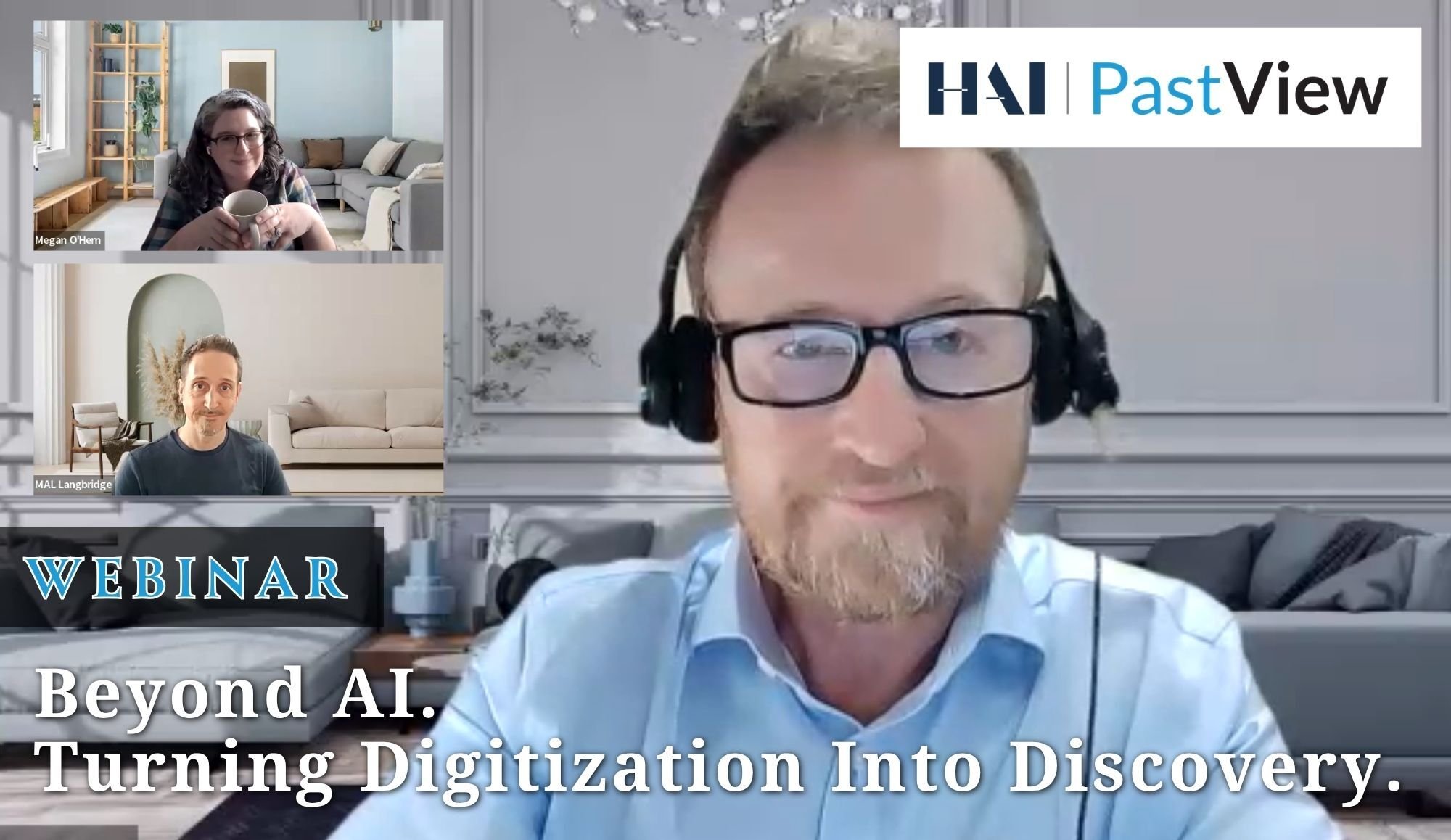
WEBINAR RECORDED ON 24TH SEPTEMBER 2026

**Above:** Our webinar panelists
Artificial intelligence is already changing how heritage organizations, archives, and museums work with their collections. But adopting AI is not simply a question of choosing the latest technology.
The bigger question is *'**how do we use AI responsibly to make digitized collections genuinely easier to discover, explore, and understand?'***
That was the focus of our recent webinar, **Beyond AI** | **Turning Digitization into Discovery**, presented alongside [History Associates Incorporated (HAI)](https://www.historyassociates.com/pastview/).
Bringing together archival expertise and the technology behind [PastView](http://pastview.com), the session explored how organizations can prepare collections for AI, where the technology can genuinely add value, and why human expertise remains central to the process.
## The Growth of AI Adoption
Megan O’Hern Crook, Director of Archives and Information Services at HAI, opened the webinar by sharing findings from HAI’s recent research into how professionals are using AI.
The research showed that adoption is already widespread, with **87% of professionals surveyed using some form of AI tool** for tasks such as drafting and summarizing.
Trust, however, remains more complicated.
Only **44% said they trusted AI outputs**, while **40% were concerned about the potential reputational impact of moving too quickly with AI**. At the same time, **85% wanted stronger ethical guardrails or independent auditing around its use**.
For archives and heritage organizations, this is particularly important. Accuracy, provenance, and context are fundamental to the value of historical collections. A technology that makes information easier to access can be enormously powerful, but only when organizations remain confident in where that information came from and how it was produced.
## Is Your Collection Ready for AI?
Before introducing AI, organizations first need to understand the collections they are working with.
HAI highlighted five areas that should be considered when assessing readiness:
**- Volume and scope:** How large is the collection, what formats does it contain, and what will be required to digitize and process it?
**- Content and access goals:** What information does the collection contain, and how do you expect researchers or audiences to use it?
**- Existing metadata and organization:** What descriptive information already exists, and how is the collection structured?
**- Rights and ethics:** Do you have the appropriate permissions to process the material, and are there ethical implications in using technologies such as facial recognition or AI enrichment?
**- Storage and infrastructure:** Where will the digital assets and associated metadata live, and how will they be maintained and preserved?
These questions help create a roadmap for digitization and discovery rather than introducing technology without first understanding the collection.
## Why Metadata Still Matters
One of the clearest themes throughout the webinar was that **AI does not make traditional archival metadata less important. In many ways, it makes it even more valuable.**
AI can identify patterns and extract information at a scale that would be extremely difficult to achieve manually.
For example, image recognition might identify thousands of photographs containing trees. But if a researcher is interested in trees on one particular street during a specific decade, traditional archival metadata, including collection structure, provenance, dates, and locations provides the context needed to refine that search. The same principle applies across collections.
OCR, handwritten text recognition, and AI enrichment can dramatically increase the amount of searchable information available, but strong descriptive metadata provides the framework that makes those results meaningful.
Technology enhances discovery; it does not replace archival context.
## A Human-Guided Approach to AI
Responsible AI was another major theme of the session.
HAI described its approach as **human-guided AI**, using technology to accelerate repetitive and scalable tasks while keeping professional judgment, interpretation, and accountability with people.
This means maintaining human oversight, verifying information against archival records, protecting provenance, and being transparent about where AI has been used.
It also means recognizing that different collections require different levels of review.
In some cases, reviewing a representative sample of AI-generated metadata may be appropriate. For sensitive or historically significant collections, much greater human verification may be required.
The objective is not to remove archivists from the process. It is to allow AI to amplify their expertise.
## Making Collections Searchable with PastView
During the second half of the webinar, PastView founder and CEO Paul Sugden and CTO Mal Langbridge demonstrated how these ideas are being applied within PastView.
PastView brings together digitized photographs, books, maps, artwork, documents, audio, and video within a searchable collections platform, with tools designed to improve both discovery and online engagement.
Several AI-assisted features were explored during the session.
### Handwritten Text Recognition (HTR)
PastView can convert handwritten documents into searchable text, making previously difficult-to-search collections significantly more accessible.
The system can recognize more than 60 languages and scripts, with the option to target particular languages when required.
Recognized text can also be edited directly within PastView, allowing archivists to review and improve the information where necessary.
### Optical Character Recognition (OCR)
Printed and typed documents can be processed using Optical Character Recognition, turning text contained within digitized images into searchable information.
Rather than researchers manually working through hundreds or thousands of pages, searches can surface relevant terms directly within the material.
### Audio Video Transcription (AVT)
Audio and video collections can also become searchable. PastView can automatically transcribe spoken content, identify speakers, and detect topics within recordings.
Search results can then take users directly to the relevant point in a recording, transforming lengthy audio and video collections into information that can be explored in seconds.
### Facial recognition
PastView is also developing facial recognition technology that can help identify individuals across photographic collections.
Once an archivist identifies a person, the technology can locate potential appearances of that individual elsewhere in the archive.
Importantly, the emphasis remains on human approval. Suggested matches are reviewed before being formally associated with collection items.
## Combining Specialist and Generative AI
PastView's AI development uses two complementary approaches.
The first is **task-specific AI** — specialized technology designed to perform particular jobs such as text recognition or facial recognition.
The second uses **generative AI combined with Retrieval-Augmented Generation (RAG)**.
Instead of asking an AI model to draw from the wider internet, this approach allows it to work from the organization's own collection data.
Information extracted through technologies such as handwritten text recognition, OCR, or image recognition can then provide additional context for generating summaries, keywords, tags, and descriptive metadata.
The result is potentially richer and more useful metadata while reducing the risk of invented or irrelevant information.
Generated content remains subject to human approval before publication.
## Beyond Simple Search
Making collections discoverable is not only about finding information. It is also about creating an engaging way for audiences to experience it.
During the webinar, several PastView presentation tools were demonstrated, including **Book Explorer**, which recreates the experience of browsing digitized books and publications; **Deep Zoom**, which allows users to explore extremely high-resolution maps, drawings, and artworks; and the **Object Viewer**, which allows photographed objects to be rotated and examined from different angles.
Existing PastView collections demonstrate how these technologies can work across very different types of archive — from corporate history and engineering collections to military archives, historic magazines, and local heritage material.
The technology may vary, but the objective remains the same: helping audiences get closer to the collection.
## From Digitization to Discovery
Digitization is an important milestone, but it is not the end of the journey.
A collection can contain thousands, or millions, of beautifully digitized pages and still be difficult to use if people cannot find what they are looking for.
The real opportunity comes from combining archival knowledge, structured metadata, and carefully applied technology.
AI can help unlock information at a scale that was previously impractical. OCR can surface words hidden inside scanned documents. Handwritten text recognition can open up manuscripts. Transcription can transform audio and video archives. Image recognition can reveal connections across huge photographic collections.
But these technologies work best when they sit alongside the expertise of the people who understand the collections, and that is how digitization becomes discovery.
### Frequently asked questions
- **AI can make digitized archives easier to discover.** Technologies such as **Hand Written Text Recognition (HTR)**, **Optical Character Recognition (OCR)**, audio and video transcription, and facial recognition can help surface information across large collections.
- **Metadata still matters.** Strong archival metadata provides the context, structure, and provenance that make AI-powered search results more meaningful and useful.
- **Human oversight remains essential.** The webinar emphasized a **human-guided AI** approach, where AI supports repetitive tasks while archivists retain responsibility for verification, interpretation, and approval.
- **PastView combines specialist AI with Retrieval-Augmented Generation (RAG).** This allows AI to work from an organization's own collection data to support richer metadata, summaries, keywords, and tags.
If you'd like to learn more about PastView, it's immersive access and discovery features, as well as revenue generating capabilities, [reach out to our friendly team today!](https://www.pastview.com/contact/)
If you'd like to get in touch with HAI, you can also do so here [historyassociates.com/contact](https://www.historyassociates.com/contact/)
[\< Back to the blog](https://blog.townswebarchiving.com/pastview)
- [Tweet](https://twitter.com/share)
## Keep up to date
Sign up to our newsletter and be the first to know about the latest access & discovery news and updates.

## Quick Links
- [About PastView](https://pastview.townswebarchiving.com/about)
- [Our Work](https://pastview.townswebarchiving.com/our-work/)
- [Events](https://pastview.townswebarchiving.com/events/)
- [PastView Community](https://blog.townswebarchiving.com/pastview/community)
- [Contact](https://pastview.townswebarchiving.com/contact)
## Built For
- [Cultural Heritage](https://pastview.townswebarchiving.com/buil-for/cultural-heritage)
- [Government](https://pastview.townswebarchiving.com/buil-for/government)
- [Industry](https://pastview.townswebarchiving.com/buil-for/industry)
- [Materials](https://pastview.townswebarchiving.com/buil-for/materials)
## Get in touch
- The Barn, Rothwell Grange Farm, Rothwell Rd, Kettering, NN16 8XF
- 01536 713834
- hello@townswebarchiving.com
-
- [Cookie Policy](https://pastview.townswebarchiving.com/cookie-policy/)
- [Terms & Conditions](https://pastview.townswebarchiving.com/terms-conditions/)
- [Privacy Policy](https://pastview.townswebarchiving.com/privacy-policy-2/)
- [Site Map](https://pastview.townswebarchiving.com/wp-sitemap.xml)
- [Browser Support](https://pastview.townswebarchiving.com/browser-support-standard/)
© TownsWeb Archiving 2023, all rights reservered
```json
{
"@context" : "https://schema.org",
"@type" : "BlogPosting",
"author" : {
"@type" : "Person",
"name" : "Paul Marks",
"url" : "https://blog.townswebarchiving.com/pastview/author/paul-marks"
},
"dateModified" : "2026-10-02T08:21:13.802Z",
"datePublished" : "2026-09-25T13:00:00.000Z",
"headline" : "Beyond AI | Turning Digitization into Discovery (Webinar)",
"image" : [ "https://blog.townswebarchiving.com/hubfs/Blog%20Header%20&%20Images%20-%202026-09-25T103527.658.jpg" ],
"mainEntityOfPage" : {
"@id" : "https://blog.townswebarchiving.com/pastview/beyond-ai-turning-digitization-into-discovery-webinar",
"@type" : "WebPage"
},
"publisher" : {
"@type" : "Organization",
"logo" : {
"@type" : "ImageObject",
"url" : "https://blog.townswebarchiving.com/hubfs/TWA%20-%20PV%20Logos.png"
},
"name" : "TownsWeb Archiving"
}
}
```