
Glyndebourne was one of three winners of our 2025 TownsWeb Archiving Digitisation Grant.
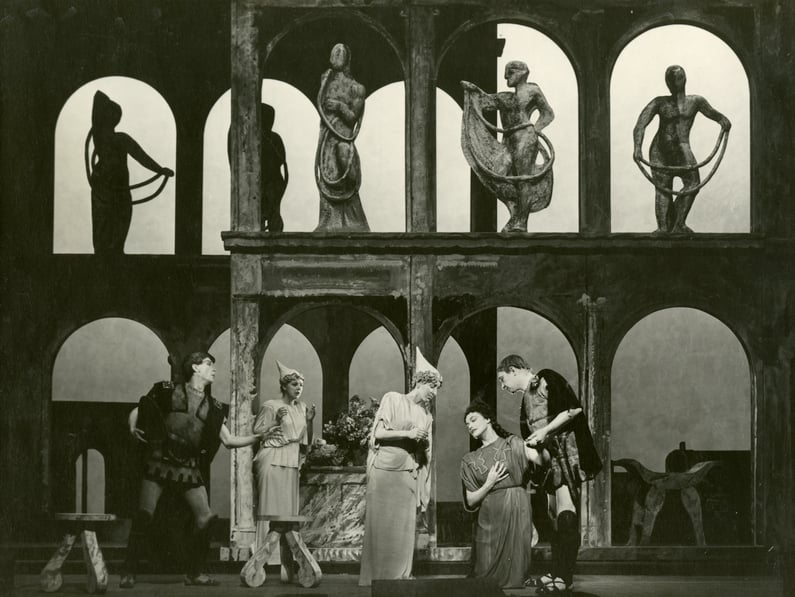
We had the pleasure of digitising a collection of materials relating to The Rape of Lucretia (1946), Glyndebourne’s first-ever commissioned opera and a work that is almost entirely absent from its published histories.
The collection, comprising more than 2,000 pieces of correspondence, potentially reveals the real story behind Benjamin Britten’s split from Glyndebourne. Previously attributed to a personal falling-out with founder John Christie, the letters instead show that the disagreement centred on budget.
We were delighted to sit down with Philip Boot, Archivist at Glyndebourne, to shed some light on this fascinating piece of history.
Philip highlighted one particularly remarkable letter in the Glyndebourne archive that never made it into a single history book. Dated 19 February 1946, it came from the office of the Lord Chamberlain, the government body once responsible for censoring material deemed indecent for the British stage.
In the letter, two lines from the libretto of The Rape of Lucretia are singled out and struck through, having been judged unsuitable for audiences of the day.
Reading it now, the objections seem almost quaint. But the letter has never been published, never been quoted in a biography, never featured in a Glyndebourne retrospective. It exists in exactly one place: a box in the Glyndebourne Archive, alongside more than 2,000 other pieces of correspondence documenting the making of an opera from start to finish.
Watch the full interview with Philip Boot, Archivist at Glyndebourne below:
An archive of everything
Glyndebourne, has been staging opera since 1934. Its archive reflects the full span of that history - correspondence, building plans, business papers and contracts, alongside costume bibles, pro files, photography dating back to the company's founding, and a collection of around 600 artworks spanning stage and costume designs, prints, and portraits.
As Philip Boot, Archivist at Glyndebourne, explains, it isn't an archive about opera in general. "We're not an opera archive, we're an archive for Glyndebourne itself."
Despite its scale, the archive had never been formally catalogued until relatively recently. Over the past two to three years, the team has been working through the collection using a new cataloguing system, identifying material that was underrepresented, poorly understood, or difficult for researchers to access - often simply because of its location.
One collection stood out immediately: the material relating to The Rape of Lucretia, Glyndebourne's first-ever commission, which premiered on site in 1946.

The opera that history left out
The Rape of Lucretia is a curious omission from Glyndebourne's own story. Despite being both a commercial and critical success, it's almost entirely absent from the various biographies and histories written about the company. Nobody at Glyndebourne today is entirely sure why.
It may simply be that the material wasn't part of the archive when those books were written. But there's another, more human possibility: the production marked the breakdown of the working relationship between Glyndebourne and composer Benjamin Britten, and the collection may have been quietly left alone out of respect for the people involved.
Whatever the reason, the result is a genuinely untapped resource - one that, as Philip puts it, captures "the making of an opera from start to finish" in a way no other production in Glyndebourne's history has been documented.

What the letters actually show
Popular accounts of the Britten–Glyndebourne split have often suggested that founder John Christie fell out with Britten over his lifestyle. The correspondence tells a different story entirely.
What it shows instead is a relationship that started well - Britten and his partner, tenor Peter Pears, stayed at Glyndebourne's country house for an extended period, and by all accounts things were amicable. The breakdown, when it came, was about money: Britten doubled the production budget, and Christie's patience wore thin. From Glyndebourne's side, particularly for general manager Rudolf Bing and Christie himself, it became personal. From Britten's perspective, it was a professional decision, driven by the need to use Glyndebourne as a vehicle to get the opera made.
The strain was visible enough that, on opening night, Christie reportedly apologised to members of the audience for what they were about to see. Britten didn't return to Glyndebourne again during his lifetime; his operas continued to be staged there in 1947, but only after his death did he return to the repertoire in any real sense, with A Midsummer Night’s Dream in 1981.
Beyond the central relationship, the archive captures an extraordinary range of decision-making from significant artistic choices about the libretto to the distinctly unglamorous logistics of running an opera house: whether there was enough hand soap, whether the seats were comfortable, who was staying in which room of the house, who received tickets for opening night.
A collection with reach beyond Glyndebourne
The material doesn't only tell Glyndebourne's story. Because of the collaborative nature of opera production, the archive also connects to other institutions and their own collections, including the Red House, home to the Britten–Pears archive, and material relating to Sadler's Wells and the John Lewis archive.
Researchers already come to Glyndebourne from across the spectrum - university academics, family historians, and simply curious members of the public. But access, until now, has meant booking an appointment and making the trip to the South Downs in person.

Why digitisation changes everything
The collection itself is deceptively compact - just three boxes - but it holds over 2,000 individual pieces of correspondence. Before digitisation, the only way to share it with a researcher unable to visit in person was, in Philip's words, "somebody like me just taking quick snapshots on their phone to send to researchers." Sending the physical letters themselves was never an option.
With the material now digitised, Glyndebourne will be able to catalogue the collection at item level and make it available online in batches, through their website and archive database. Researchers anywhere in the world will be able to explore the correspondence in full, without needing to travel or book an appointment.
For a letter like the one from the Lord Chamberlain, a document that exists nowhere else, in no publication, referenced in no biography - that's a significant shift. It means a piece of theatrical and social history that has sat quietly in a box for nearly 80 years can finally be seen.

What comes next
Completing this project has already prompted Glyndebourne to think about what else in the archive deserves the same treatment. Candidates include correspondence from the company's founding, material from its first tour in 1940, and the substantial holdings of architectural plans, artworks and stage designs that researchers frequently request.
As Philip puts it, the project has pushed the team to ask sharper questions about their own collection: "What do researchers want to access? What can we give them quite easily? And what do we need to have a serious think about digitising in the future so that access is made a lot easier?"
Working with TownsWeb, he says, has been straightforward from the outset, with clear communication, an easy collection process, and material returned in pristine condition, fully labelled and catalogued exactly as required.
For any archive weighing up whether to pursue a similar grant or digitisation project, Philip's advice is simple: do it. "It really has made us interrogate our material in a much deeper way." Beyond the immediate project, it's also given Glyndebourne a trusted partner for the material they can't digitise in-house - a reassurance, as much as anything, for whatever comes next.
Eighty years after its premiere, The Rape of Lucretia can now finally get the attention it deserves.
You can visit the Glyndebourne Opera Archive here: https://www.glyndebourne.com/opera-archive/
 CALL US
 REQUEST A FREE
 USE OUR ONLINE